- Jan 1, 2025
Am I Really Hungry? A Guide to Understanding Your Hunger
- Emma Townsin
- Intuitive Eating
Understanding the Different Stages of Hunger and When is the Best Time to Eat
Do you find yourself waiting for that rumbling stomach or a sudden drop in energy before you eat? By the time we’re experiencing these hunger symptoms, it can make us more likely to have cravings and urgency toward food. If you’ve ever wondered whether your hunger cues are out-of-control or if you can trust them, this post will help you explore the different ways your body communicates hunger and when you should be eating.
Hunger Is Just Communication from Your Body
At its core, hunger is simply a way for your body to communicate its needs. This communication occurs through interoception, which is the body’s sense of what’s going on inside—everything from needing to pee to experiencing emotional states. Hunger and fullness are also felt through this inner sense, though for many people, hunger can be difficult to recognise or trust.
There are various reasons for this. For instance, some of us weren’t encouraged to trust our hungry as children. For others, dieting or rules of when to eat may be trusted over our body's hunger signals. Or if there has been a time food isn’t regularly available, hunger may have become suppressed or ignored. These things can leave us out of tune with our body’s signals.
For those usually attuned with hunger, being distracted, stressed, or struggling with emotional issues can temporarily leave us less able to recognise or respond to earlier hunger as well.
The good news? It’s possible to reconnect with your body’s hunger cues so you can feel more confident around food.
Understanding the Stages of Hunger
Our hunger doesn’t just appear as an intense craving or an urgent need for food. Hunger gradually progresses in stages, and the earlier signs are often more subtle. For example, when we first need to use the bathroom, the sensation is typically mild, allowing us to continue with other tasks. But as we delay going to pee, it becomes harder to focus on anything else, and the urgency increases. Hunger works in a similar way.
Here are the stages of hunger you might experience:
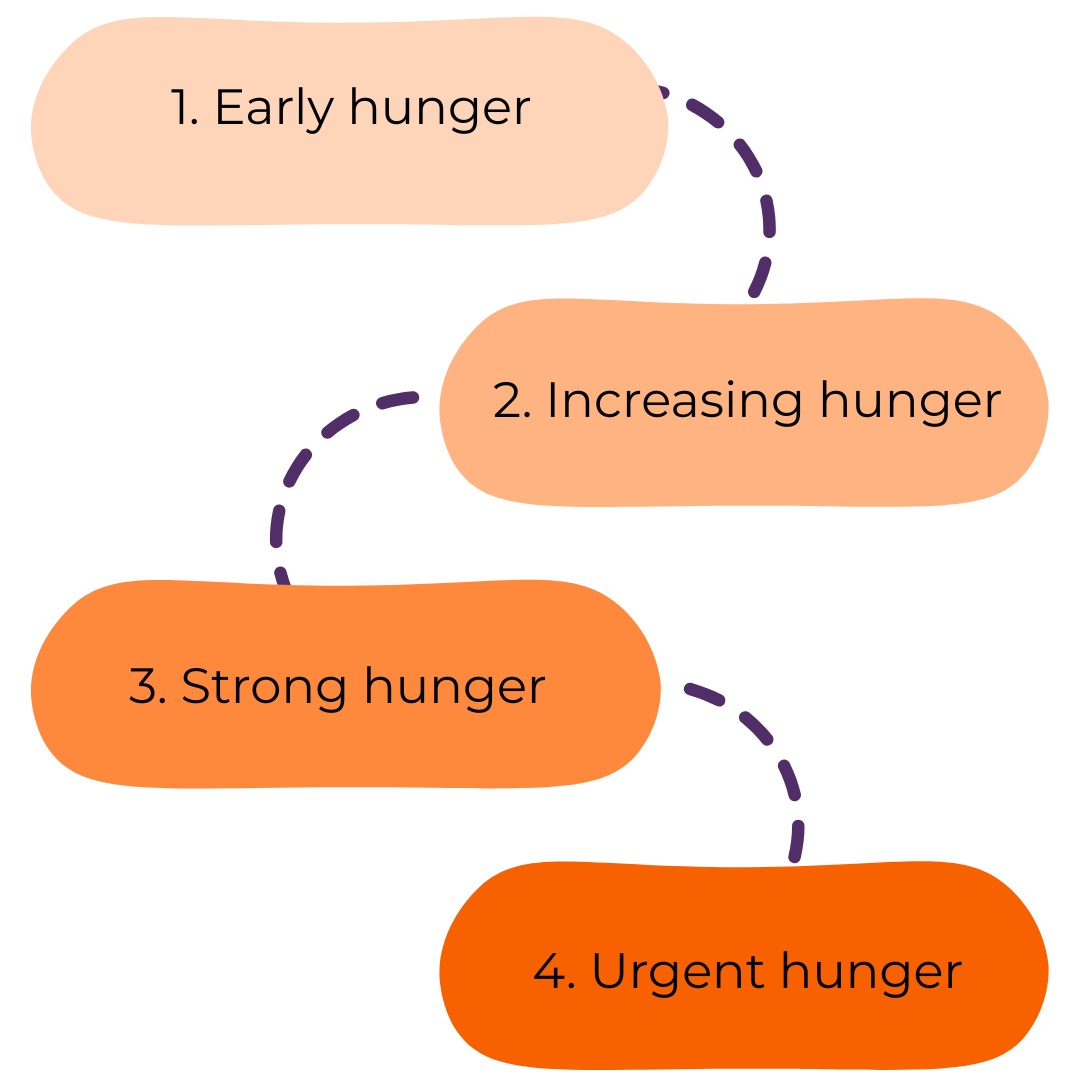
Early Hunger: The first signs of hunger may be subtle—perhaps a slight thought about food or the scent of food starting to become more noticeable. At this point, the sensation in your stomach may not be noticeable.
Increasing Hunger: As hunger progresses, you may start to feel more empty in your stomach or notice a decrease in your energy levels. You might also begin to think about food more frequently, but at this stage, the thoughts are still relatively calm and not overwhelming. You can choose satisfying foods without urgency.
Strong Hunger: The hunger becomes stronger, and your thoughts are more consumed by food. You may experience physical sensations like stomach grumbling, weakness, or tiredness. Your body starts to crave energy-rich foods to fuel itself, and your emotions might become affected.
Urgent Hunger: At this stage, hunger feels intense and urgent and it's likely difficult to focus on other tasks. You might feel irritable, weak, and even sick. Your stomach could hurt, and food seems like an immediate necessity. You’re unlikely to make mindful food choices as it’s all about satisfying the immediate hunger quickly, not about long-term nourishment.
Why You Shouldn’t Wait for Urgent Hunger
While it’s tempting to think that waiting as long as possible to eat will help us consume less, this strategy often backfires. When we wait too long, we don’t just feel hungry—we feel ravenous, which leads us to make less mindful food choices. At this point, we're more likely to crave foods that are high in energy and less nutrient-dense. Moreover, eating when we’re already in a state of urgent hunger makes it harder to recognise when we’re full.
Waiting for hunger to become urgent doesn’t reduce our food intake, it just makes eating less enjoyable and harder to connect with our body’s true needs. You might notice that it’s difficult to enjoy a variety of foods, especially those that provide long-term energy and nourishment, such as fruits, vegetables, and whole grains.
Attuning to Your Unique Hunger Cues
It’s important to remember that everyone experiences hunger differently. For some people, hunger is felt in the stomach, while others might notice it in their mouth, throat, head, chest, or even their limbs. Hunger can even manifest as mental cravings, which are just as valid as physical cues.
The key is to learn what hunger feels like for you—whether it’s the physical sensations or the mental cravings—and to eat before hunger reaches the urgent stage. To help you identify your personal hunger cues, try drawing a line with “early hunger” on one end and “urgent hunger” on the other. Then, jot down what you notice at different points on this line. Do you experience subtle signs early on? What do food thoughts feel like at different stages?
If you consistently miss the earlier signs of hunger and only feel urgency, it’s time to start eating before that happens. Try to eat regularly (every 3-4 hours, for example) to help your body reconnect with its hunger cues.
The Cycle of Hunger and Stress Around Food
Worrying about eating too much when you eat in response to earlier hunger is common. However, when we wait until we’re ravenous, it leads to overeating and cravings for high-energy foods. This cycle of ignoring hunger until it becomes urgent creates an unhealthy relationship with food, making it harder to trust our body’s signals.
As a Specialist Eating Disorder Dietitian and Certified Intuitive Eating Counselor, I often see this pattern in my clients. It’s vital to address this early on, because until your body’s physical hunger needs are met, it’s difficult to distinguish whether emotional or other underlying issues are at play.
If you find yourself struggling with hunger cues, or food-related stress, learn how the Finding Your Food Freedom course can help.
Understanding hunger and reconnecting with your body’s needs is the first step toward building a healthier, more intuitive relationship with food.
What you can do now
Tuning into your hunger and fullness mini course is the perfect bite-sized actionable course to trusting your hunger and reducing overeating. You deserve to start feeling confident around food today!
👉Check it out and start instantly - only £20!
Final Thoughts
Remember, hunger is a natural part of life, and it’s essential to listen to the subtle cues your body gives you before they turn into urgent, ravenous feelings
If you found this helpful:
✅ Listen to the Food & Life Freedom Podcast
✅ Share this post with someone who will find it helpful.
✅ Check out the Tuning into hunger and fullness Mini Course.
.
You deserve to feel at peace around food. Let’s start today!